


test2
Last Updated on: February 9, 2026
This enterprise guide explains how AI development services help organisations design and scale secure, production-ready Generative AI architecture.
It covers core layers including data processing, generative models, feedback loops, and deployment, along with key technologies such as GANs, VAEs, and transformer-based systems.
The article also explores enterprise use cases across code generation, content creation, marketing, and product design, while addressing implementation challenges like data privacy, security, and infrastructure complexity. It highlights how Systango and GenAI Studio support businesses in moving from experimentation to scalable, compliant Generative AI solutions.
Key Takeways
I. Why Generative AI Architecture Matters for Enterprises
III. Core Pillars of Generative AI Architecture
V. Enterprise Applications of Generative AI
VI. Challenges in Enterprise Implementation
VII. Best Practices for Enterprise AI Implementation
VIII.-Future-Trends-in-Generative-AI-Architecture
Generative AI is no longer just the next wave of artificial intelligence; it is reshaping how enterprises build products, engage customers, and drive innovation. While traditional AI focuses on analysing data and making predictions, Generative AI goes further by creating original content, code, and designs.
With the right AI development services, organisations can turn this capability into measurable business value; accelerating delivery, improving productivity, and enabling hyper-personalised customer experiences. For today’s leaders, the real question is no longer what Generative AI is, but how Generative AI architecture should be designed to deliver secure, scalable, and sustainable impact.
This enterprise guide explains the fundamentals of Generative AI architecture, covering core components, enterprise use cases, implementation challenges, best practices, and future trends; helping business leaders and decision-makers move confidently from experimentation to production.
I. Why Generative AI Architecture Matters for Enterprises
Without a well-designed Generative AI architecture, organisations often face fragmented systems, security risks, and models that never progress beyond pilot projects. A structured architectural approach enables enterprises to deploy AI faster, govern it responsibly, and scale innovation across teams.
This is why modern businesses increasingly rely on AI consulting services and AI development services to operationalise Generative AI effectively.
This approach helps enterprises reduce time-to-market, improve operational efficiency, and unlock new revenue opportunities.
II. What is Generative AI?
Generative AI is a subset of artificial intelligence that uses deep learning models to generate original outputs from learned data patterns. Unlike rule-based systems, it creates content independently, making it versatile for multiple applications. Key aspects include:
- Autonomous Content Creation: Generates text, visuals, audio, and code without explicit instructions.
- Pattern Learning: Analyses large datasets to replicate patterns in novel ways.
- Industry Versatility: Applies to content creation, design, analytics, product development, research, and more.
For enterprises working with a Generative AI Company, this means saving time, improving efficiency, and scaling human creativity with tailored AI software development solutions.
III. Core Pillars of Generative AI Architecture
Understanding generative AI requires examining its four foundational layers:
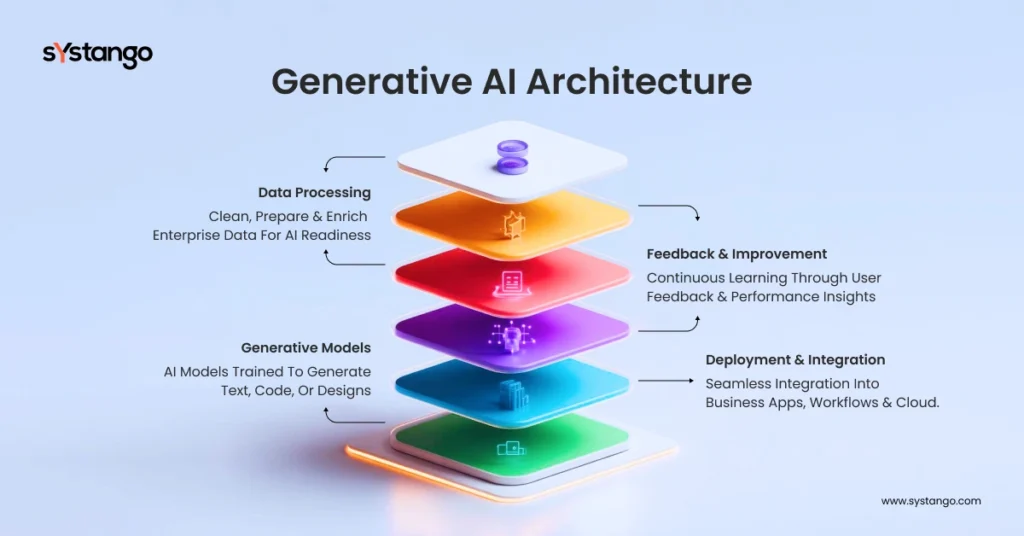
- Data Processing Layer
- Cleans, normalises, and transforms raw data into formats suitable for AI models.
- Prepares text, images, and audio for training while ensuring quality and consistency.
- Cleans, normalises, and transforms raw data into formats suitable for AI models.
- Generative Model Layer
- The engine of creativity, where models learn hidden data patterns.
- Includes architectures such as GANs, VAEs, and transformers.
- Converts input data into novel outputs through algorithms and neural networks.
- The engine of creativity, where models learn hidden data patterns.
- Feedback and Improvement Layer
- Implements continuous learning through human feedback and automated metrics.
- Refines outputs and enhances model accuracy over time.
- Implements continuous learning through human feedback and automated metrics.
- Deployment and Integration Layer
- Integrates models into applications like chatbots, code assistants, image generators, and marketing tools.
- Often supported by AI consulting services to ensure scalability and seamless enterprise adoption.
- Integrates models into applications like chatbots, code assistants, image generators, and marketing tools.
IV. Key Generative AI Models
- Generative Adversarial Networks (GANs):
Two neural networks, the generator and the discriminator, compete to produce hyper-realistic content. Used in image, video, and music generation. - Variational Autoencoders (VAEs):
Compress and reconstruct data to produce new outputs while preserving the essence of the original data. Applied in image synthesis, music, and text generation. - Transformer-Based Architectures:
Excel in natural language processing, enabling content generation, language translation, and code creation. Examples include GPT-series and BERT derivatives.
These models, when integrated with AI development services, can be adapted for domain-specific enterprise applications.
V. Enterprise Applications of Generative AI
Generative AI is transforming businesses across industries:
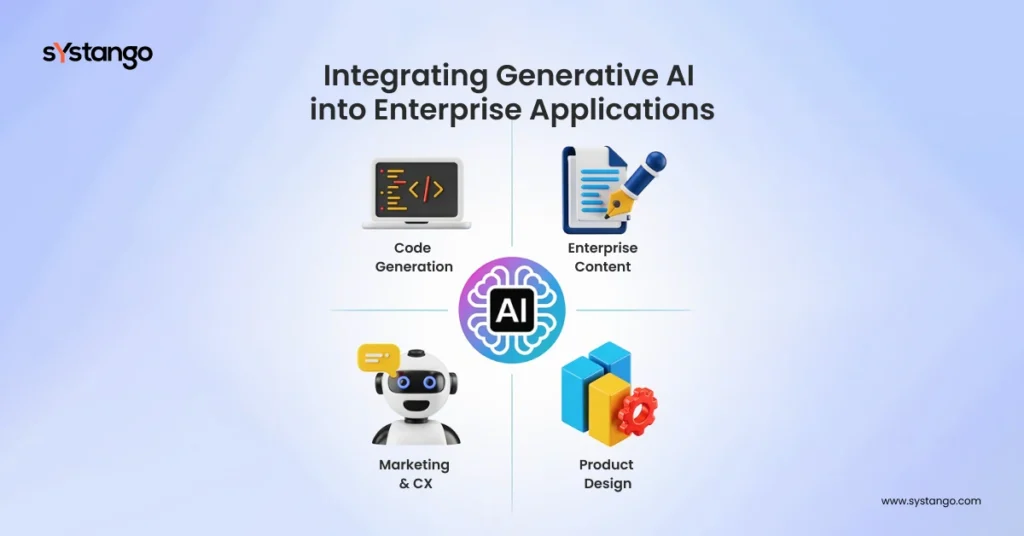
- Code Generation
- Tools like GitHub CoPilot and Codex assist developers by suggesting code snippets, fixing errors, and accelerating development.
- Reduces repetitive coding tasks and frees teams for strategic problem-solving.
- Content Creation and Management
- Supports drafting articles, marketing copy, and design prototypes.
- AI-powered platforms like Figma and Stackbit enable efficient and creative GUI design.
- Supports drafting articles, marketing copy, and design prototypes.
- Marketing and Customer Experience (CX)
- Delivers personalised campaigns, product recommendations, and AI-driven customer support.
- Enhances engagement through tailored content and predictive analytics.
- Delivers personalised campaigns, product recommendations, and AI-driven customer support.
- Product Design and Engineering
- Assists in early-stage ideation, simulation, and optimisation for product lifecycle management (PLM).
- Suggests materials, structure, and design improvements for cost efficiency and sustainability.
- Assists in early-stage ideation, simulation, and optimisation for product lifecycle management (PLM).
Partnering with a Generative AI Company ensures these applications are designed to meet enterprise-specific goals.
VI. Challenges in Enterprise Implementation
Enterprises face several hurdles when deploying generative AI:
- Security Concerns: Risk of malicious content or model manipulation. Implement monitoring and content moderation.
- Data Privacy: Ensure anonymisation, differential privacy, and compliance with regulations like GDPR and CCPA.
- Computational Requirements: High-performance GPUs, cloud platforms, and edge computing may be necessary for large-scale operations.
- Engaging with AI consulting services helps enterprises address these challenges strategically.
VII. Best Practices for Enterprise AI Implementation
- Custom Models: Tailor AI architectures to industry-specific needs (fraud detection, product recommendations).
- Infrastructure Alignment: Use scalable cloud resources, hybrid setups, and containerised deployments.
- Security Measures: Encrypt data, control access, and monitor model outputs continuously.
- Regulatory Compliance: Maintain clear data ownership, perform audits, and communicate safeguards.
- Industry Collaboration: Partner with a Generative AI Company or experts in AI development services to ensure best practices.
VIII. Future Trends in Generative AI Architecture
As enterprises continue to explore the potential of generative AI, the architecture behind these systems is also evolving. The next few years will witness rapid advancements that make AI smarter, more adaptable, and widely accessible. Below are some of the most important trends shaping the future:
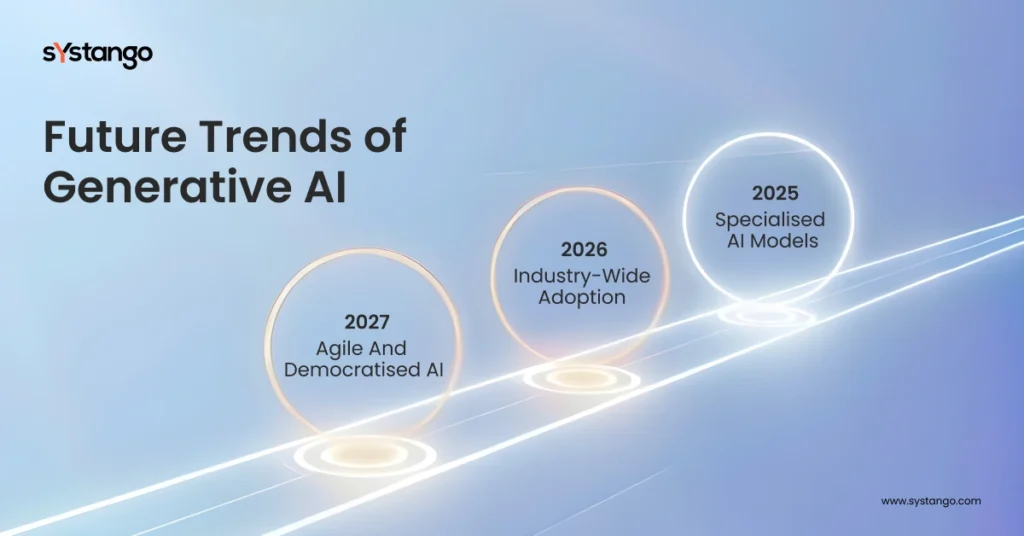
- Specialised AI Models: Domain-specific models will outperform general-purpose AI by excelling in niche areas such as healthcare diagnostics, legal analysis, or financial fraud detection.
- Industry-Wide Adoption: Sectors like manufacturing, healthcare, education, and retail are rapidly embracing generative AI to boost efficiency, decision-making, and customer engagement.
- Agility and Adaptability: Future models will dynamically adjust to evolving data, market trends, and customer preferences, ensuring enterprises remain competitive.
- Democratisation of AI: Accessible platforms, open-source solutions, and sustainable AI software development frameworks will empower businesses of all sizes to adopt generative AI at scale.
IX. Conclusion
Generative AI is no longer just a technological breakthrough; it is a foundation for enterprise transformation. A well-designed Generative AI architecture, from data processing to deployment, enables organisations to innovate faster, automate intelligently, and deliver hyper-personalised experiences at scale. By adopting bespoke architectures, enterprises can maximise potential while ensuring security, compliance, and long-term adaptability.
This is where GenAI Studio stands apart. Unlike traditional solutions, it offers:
- End-to-end platform for designing and scaling AI software development
- Built-in governance, ethics, and compliance for enterprise trust
- Seamless integration supported by expert AI consulting services and AI development services
- Leaders to move from pilots to enterprise-wide adoption
The future of Generative AI will belong to enterprises that don’t just adopt AI—but architect it right. Through Systango and its GenAI Studio platform, organisations gain end-to-end support for building secure, scalable Generative AI systems, backed by expert AI consulting services and AI development services. Together, they enable businesses to move from pilots to enterprise-wide adoption with confidence.